


2026年03月26日
Imagine the mist-shrouded peaks of China's Jiangnan region in the 16th century. The air is thick, the forests are a vibrant emerald, and the culture of an entire empire is undergoing a quiet, yet profound, revolution. For centuries, the Chinese upper echelons consumed tea in a highly processed form. During the Tang and Song dynasties, tea leaves were pulverized, steamed, and compressed into elaborate, hard bricks known as "Dragon Cakes" and "Phoenix Bricks." To drink tea meant to grind these cakes into a fine powder and whisk them into a frothy paste—a beautiful, yet highly manipulated, ritual.
However, the trajectory of this ancient botanical culture was forever altered by a dramatic imperial decree. In the autumn of 1391, Emperor Zhu Yuanzhang, the founder of the Ming Dynasty, issued a mandate that shook the foundations of the tribute system: the production of compressed tea cakes was to be abolished immediately, replaced entirely by the presentation of loose-leaf tea.
This monumental shift from the laborious grinding and pressing of the past to the gentle pan-firing of loose leaves initiated a golden age of tea connoisseurship. The Ming dynasty literati, scholars, and poets began to revere tea in its most unadulterated, pristine state. They sought the "true nature" of the leaf—a beverage whose vibrant green color and delicate, lingering taste required no artificial contrivance.
Yet, this pursuit of natural perfection introduced a terrifying new enemy. Unlike the dense, rock-hard tea cakes of the past, the new loose-leaf teas were delicate, porous, and agonizingly vulnerable to the elements. They were completely exposed to the relentless, suffocating humidity of the Chinese climate. In the classic text Cha Shuo (Tea Discourse), the Ming dynasty polymath Tu Long articulated this fatal vulnerability with poetic precision: "Tea, by its very nature, loves dryness and despises moisture; it is the most difficult of all things to store."
This is the story of how an ancient philosopher confronted the unforgiving forces of nature. Through a captivating blend of deep philosophical insight and what we now recognize as advanced materials science, Tu Long devised a preservation method so ingenious that it remained unmatched for centuries. It is a tale of botanical alchemy, thermodynamic engineering, and the timeless human quest to capture and suspend the fleeting beauty of nature.
To truly understand the brilliance of Tu Long’s approach to tea preservation, we must first dive into the worldview of the Ming dynasty scholar. For the literati, tea was not merely a beverage; it was a profound spiritual conduit. Influenced heavily by Zen Buddhism, these scholars believed that tea possessed the power to deliver "sweet dew" (甘露) and "clarified butter" (醍醐)—metaphors for spiritual enlightenment, inner peace, and a profound awakening to the truths of the universe.
However, tea could only serve as a vessel for enlightenment if its "true nature" remained intact. Tu Long characterized this nature with a fundamental biological imperative: it "loves dryness and despises moisture." This was not just a passing agricultural observation; it was deeply rooted in the holistic framework of traditional Chinese medicine and philosophy.
In Chinese medical theory, the human spleen and stomach are considered the foundation of postnatal life, responsible for digesting food and transporting nutrients. The core characteristic of the spleen is precisely that it "loves dryness and hates dampness". When the human body is invaded by external dampness, the spleen's ability to function is crippled, leading to lethargy, bloating, and a stagnation of vital energy.
Tu Long brilliantly mapped this physiological blueprint onto the lifecycle of the tea leaf. When a loose tea leaf absorbs moisture from the air, it suffers from a botanical sickness—what Tu Long called the "disease of stifling" (受奄之病). A healthy, premium tea infusion should exhibit the bright, lifting energy of a clear, pale green or vibrant white, much like the glowing complexion of a healthy human being. If the tea becomes damp and sick, its color turns a heavy, turbid yellow or murky black. To the discerning eye of a tea master, this discoloration was absolute proof that the tea’s soul had been corrupted. If the tea lost its pure, unadulterated fragrance and taste, it forfeited its sacred role as a medium for Zen meditation and philosophical reflection. Absolute dryness was not just a physical requirement; it was a spiritual necessity.
Every year, as late spring transitions into summer, the Yangtze River basin is besieged by the Meiyu, or the "Plum Rain" season. For weeks on end, a relentless barrage of heavy rains and soaring humidity blankets the region. The air becomes a heavy, saturated sponge. For the Ming tea collectors, the Plum Rain was a period of sheer terror.
The standard defense of the era was pitifully inadequate. Families would wrap their precious loose-leaf teas in bamboo leaves (箬葉). While bamboo offers a rudimentary physical barrier, it is an organic, semi-permeable material. Over the agonizingly long weeks of the Plum Rain, atmospheric moisture inevitably penetrated the bamboo's cellular structure, seeping into the tea leaves and triggering a disastrous chain reaction of spoilage.
In a desperate bid to save their dampening tea, many practitioners resorted to a reactionary, aggressive technique: "constant warming and roasting" (時時溫焙). Whenever the tea felt soft or smelled faintly damp, they would place it over a gentle charcoal fire to drive out the moisture.
Tu Long observed this widespread practice and condemned it with absolute certainty. "Although they use fire to constantly warm and roast it," he wrote, "those who manage to avoid losing the tea's color are incredibly rare."
Today, peering through the lens of modern food chemistry and thermodynamics, we can see exactly why Tu Long was right. The process of re-roasting damp green tea is a recipe for chemical devastation.
The spellbinding, jade-like green of high-quality Ming loose-leaf tea is entirely dependent on chlorophyll molecules preserved perfectly during the initial pan-firing. However, chlorophyll is highly unstable when subjected to heat, especially in the presence of moisture. When the tea is repeatedly roasted over a fire, the thermal energy acts as a catalyst. The central magnesium ion within the chlorophyll's porphyrin ring is violently ejected, causing a rapid degradation. The vibrant, living green chlorophyll converts into pheophytins and pheophorbides—pigments that reflect a dull, lifeless olive-brown or dark black. Tu Long’s observation of "loss of color" was a perfect, naked-eye recording of this catastrophic molecular breakdown.
The initial manufacturing of green tea involves rapid heating to denature enzymes—specifically polyphenol oxidase and peroxidase—which prevents the tea from oxidizing. However, when dried tea absorbs moisture from the humid Plum Rain air, free water enters the leaf cells. If the tea is then heated over a fire, it briefly experiences a high-temperature, high-humidity microclimate. This can trigger rapid non-enzymatic browning, or even reactivate dormant enzymes. The abundant catechins (antioxidants) in the leaf are forcefully oxidized, polymerizing into theaflavins and thearubigins. While these compounds give black tea its desirable red color and rich body, their presence in delicate green tea destroys its defining briskness, turning the elegant liquor into a heavy, reddish-brown disappointment.
Furthermore, the ethereal aromas of premium tea—often compared by Ming scholars to blooming orange blossoms or wild orchids—are composed of highly volatile essential oils, alcohols, and aldehydes. Every time the tea is subjected to the heat of the roasting fire, these delicate, low-boiling-point aromatic compounds vaporize into the air, lost forever. In their place, the intense heat triggers the Maillard reaction, replacing the floral notes with heavy, burnt, caramelized, or harsh "charcoal" flavors.
By applying fire to combat water, the tea drinkers of the Ming dynasty were destroying the very essence they sought to save. Tu Long realized that the war against moisture could not be won with reactionary fire. It had to be won with impenetrable, proactive defense.
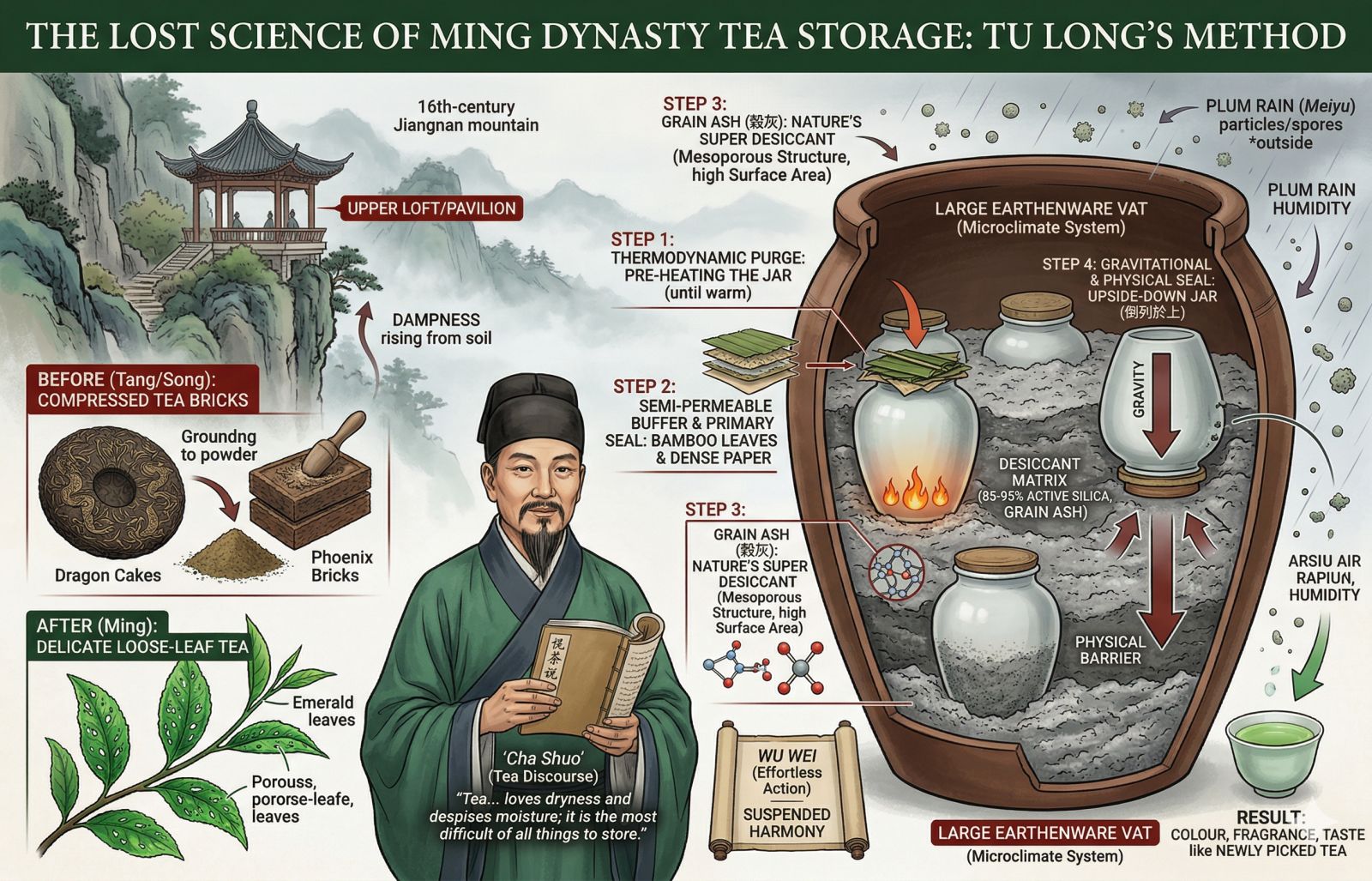
Recognizing the futility of "constant roasting," Tu Long orchestrated a radical paradigm shift in the philosophy of food preservation. He abandoned thermodynamic warfare and turned instead to materials science and spatial geometry. He engineered a multi-layered, completely passive microclimate system—the "Grain Ash and Large Vat" storage method.
Tu Long boldly proclaimed: "For the storage of tea, there is no method that surpasses this." When we deconstruct his precise, step-by-step instructions, the staggering scientific brilliance of this 16th-century technique comes to light. It is a masterclass in establishing a zero-humidity, sterile, and perfectly insulated vault.
Tu Long emphasized that the process must begin before the Plum Rain season arrives—preemption is the ultimate weapon. The first step involves taking a porcelain jar and "pre-heating it until warm."
This is not a mere cleaning ritual; it is a vital thermodynamic purge. Even seemingly dry porcelain holds microscopic layers of condensed water molecules on its surface, and the air trapped inside contains ambient humidity. By heating the jar, Tu Long effectively raised the vapor pressure, boiling off invisible moisture and ensuring that the internal environment was an absolute desert the moment the tea leaves were introduced.
Once the delicate tea leaves are placed into the bone-dry, warm jar, a layer of bamboo leaves (箬葉) is tucked into the opening. While bamboo leaves alone are insufficient for long-term storage, here they serve a brilliant secondary purpose. They act as a breathable, organic buffer that prevents the tea from touching the outer sealing materials, while gently regulating the immediate micro-atmosphere.
Following this, the jar’s mouth is sealed tight with layers of thick, dense paper. This tightly bound fiber matrix drastically reduces the rate of gas exchange, acting as the first true physical barricade against the outside world. Yet, Tu Long knew that over the span of months, microscopic moisture would eventually breach the paper. He needed an active, relentless guardian.
The most astonishing component of Tu Long's system is the introduction of a massive external buffer. He instructed his readers to take a large earthenware vat and coat the bottom with a thick layer of "grain ash" (穀灰)—the charred remains of agricultural waste, such as rice husks or wheat chaff. The sealed porcelain tea jars are placed inside the vat, and then completely buried beneath layer upon layer of this ash until the vat is brimming.
To the modern materials scientist, this use of grain ash is nothing short of breathtaking. Agricultural biomass ash, particularly from rice husks, is a highly complex, phenomenally effective natural desiccant.
A Labyrinth of Active Silica: When cereal husks are burned, the resulting ash is composed of up to 85% to 95% active silica (silicon dioxide).
Mesoporous Structure: Under a modern scanning electron microscope, this silica reveals a wildly irregular, highly porous morphological structure. A single gram of this ash possesses an immense specific surface area, stretching for dozens of square meters. It acts exactly like the little packets of industrial silica gel we find in modern electronics packaging. This deep bed of ash actively and aggressively pulls any wandering moisture out of the air inside the vat, permanently locking it within its microscopic pores.
An Antimicrobial Fortress: Beyond its extreme hygroscopic (water-absorbing) properties, biomass ash boasts an incredibly high potassium content, creating a strongly alkaline (high pH) environment. Modern in vitro testing has proven that extracts from biomass ash possess an antibacterial efficiency of up to 70.2% against dangerous pathogens like Staphylococcus aureus, while also halting the growth of fungi and mold. By burying the tea jar in this ash, Tu Long surrounded it in a barren, hyper-dry, alkaline desert where no mold spore or moisture droplet could possibly survive.
Perhaps the most elegant stroke of genius in the entire manual is a subtle instruction regarding spatial orientation: the sealed porcelain jars must be placed into the ash upside down (倒列於上).
In any container, the opening—no matter how tightly sealed with paper and string—is the weakest link. By inverting the jar and burying the mouth deep at the bottom of the ash bed, Tu Long utilized fundamental physics. First, gravity pulls the weight of the tea and the jar down upon the paper seal, compressing it against the ash and tightening the physical barrier. Second, and more importantly, any humid air attempting to infiltrate the jar must now travel through the thickest, deepest part of the silica ash matrix. Long before a single molecule of water could reach the paper seal, it is devoured by the thirsty grain ash. It is a flawless architectural defense.
Finally, Tu Long addresses the macro-environment. Once the large vat is filled with ash and sealed shut, it must be "stored in a high pavilion or loft" (貯於樓閣).
During the torrential Plum Rain season, the ground becomes saturated. Moisture rises through the soil, soaking into the floors and lower walls of traditional architecture through capillary action. By elevating the massive vat into a second-story loft, Tu Long physically removed the system from the highest concentration of ambient humidity. The loft provides superior airflow and a significantly lower baseline moisture level, perfectly complementing the microscopic defenses working silently inside the vat.
"Even after passing through the yellow plum rains," Tu Long proudly concluded, "when taken out and brewed, its color, fragrance, and taste are just like newly picked tea, and its color remains completely unchanged."
His declaration that "there is no method that surpasses this" was not the arrogant boast of an eccentric scholar; it was a scientifically verifiable fact. By eliminating heat, completely neutralizing moisture, isolating the tea from oxygen and light, and providing a sterile environment, Tu Long inadvertently perfected the four modern pillars of food preservation.
But beyond the impressive physics and chemistry, the grain ash method represents the very soul of Ming dynasty philosophy. The literati of the era despised artificial intervention. They believed that using the violent force of fire (constant roasting) to fight the natural force of water (humidity) was a crude, destructive battle that ultimately ruined the tea's spirit.
Instead, Tu Long looked to the principles of Daoism—Wu Wei, or effortless action. He took the most humble, discarded material imaginable—the burnt ashes of agricultural waste—and used its inherent, natural properties to build an invincible fortress. He did not fight nature; he orchestrated it. He used the extreme dryness of the ash to protect the fragile life of the tea leaf, allowing the two natural elements to exist in perfect, suspended harmony.
When a Ming scholar ascended to his pavilion, cracked open the sealed vat, brushed away the gray ash, and unveiled tea leaves as vibrantly green and fragrant as the day they were plucked, he was experiencing a miracle. In that cup of jade-colored liquor, he tasted not just the fleeting beauty of spring, but the brilliant, enduring triumph of human ingenuity.


